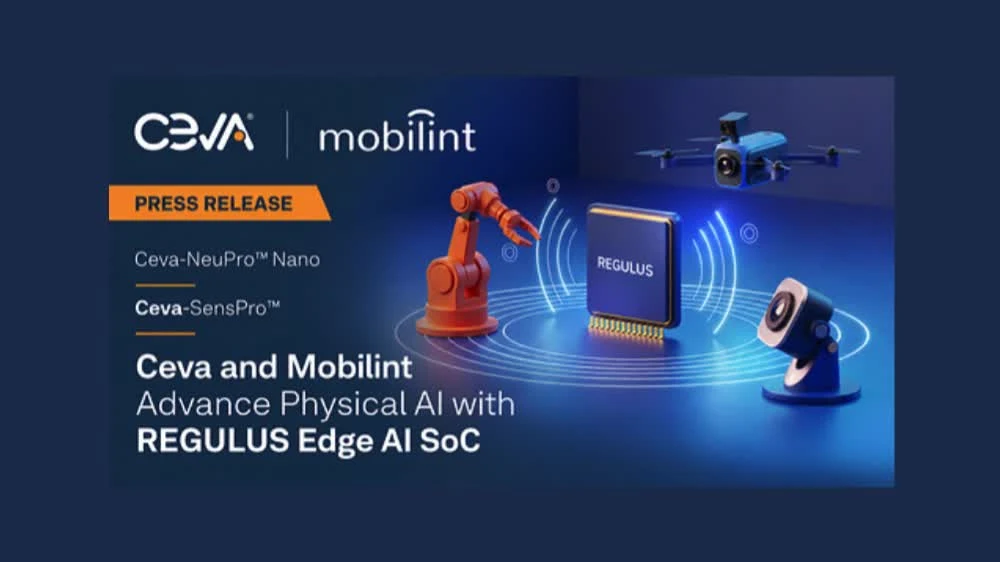
Artificial intelligence continues to expand across the physical world today. Consequently, developers process complex workloads directly where devices operate. Physical AI systems must sense, interpret, and respond to surroundings in real time. Therefore, modern engineering drives higher intelligence straight into power-constrained hardware. Ceva, Inc. announced a strategic deployment with semiconductor innovator Mobilint today. Mobilint deployed Ceva’s technology inside its new REGULUS edge AI System-on-Chip.
This release marks the first production deployment of Ceva’s NeuPro NPU family. The REGULUS SoC combines Ceva’s SensPro AI DSP with the NeuPro-Nano NPU seamlessly. Furthermore, this platform delivers advanced sensing capabilities directly to next-generation Physical AI equipment.
Multi-Engine Architecture Delivers Efficient On-Device Computing
Engineers designed REGULUS as a standalone processor for on-device artificial intelligence. The silicon integrates Ceva’s processing units within Mobilint’s architecture efficiently. Delivering 10 TOPS of performance at under 3W, REGULUS supports up to 8GB of memory. Thus, the hardware powers real-time applications across robotics, drones, machine vision, and smart cameras.
The multi-engine architecture enables different sensing workloads to run on optimal engines. For instance, SensPro provides programmable processing for signal-processing tasks. Meanwhile, NeuPro-Nano provides highly efficient neural processing for always-on inference. Together, these technologies complement Mobilint’s architecture seamlessly. The REGULUS solution adds flexible sensing features to meet evolving physical device demands.
“REGULUS brings together the specialized processing capabilities needed to run sophisticated AI workloads directly on the device within very tight power constraints,” said Dongjoo Shin, CEO of Mobilint. “Ceva’s SensPro and NeuPro-Nano add flexible sensing, signal processing and inference capabilities to REGULUS, helping us address the diverse workloads our customers need to build the next generation of intelligent edge devices.”
Commercial Deployment Expands Across Global Tech Markets
The REGULUS processor already enables commercial hardware solutions globally today. For example, the chip powers Mobilint’s MLD-R1 AI USB accelerator device. First previewed at COMPUTEX 2026, the MLD-R1 product ships to commercial customers now.
Designed to add on-device AI to existing systems, MLD-R1 supports computer vision. Additionally, it handles video analytics and generative AI workloads easily. The platform serves smart factories, robotics, medical devices, and digital signage. Furthermore, it supports widely used frameworks like PyTorch, ONNX, Hugging Face, TensorFlow, TFLite, and Keras.
“REGULUS marks an important milestone for Ceva as the first production deployment of our NeuPro NPU family, demonstrating the progress we are making in bringing our AI technology into commercial silicon,” said Yaron Galitzky, Executive Vice President and General Manager, AI Division at Ceva. “Together, NeuPro-Nano and SensPro provide efficient, flexible sensing and inference processing that helps address the diverse workloads Physical AI devices need to perform locally and in real time.”
Ultimately, the REGULUS SoC establishes a strong foundation for future edge applications. Ceva and Mobilint continue advancing hardware standards across the global technology ecosystem.
For related updates on digital trust and cybersecurity, explore our SOC News.