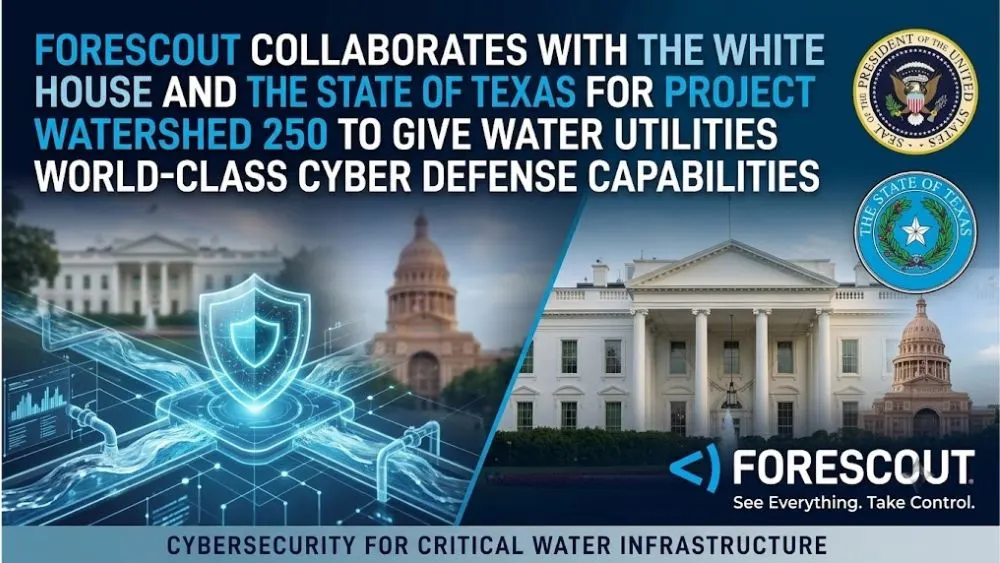
Forescout Technologies announced its key role in Project Watershed 250. The White House and the State of Texas are partnering with the cybersecurity company in a public-private partnership. Water utilities and technology leaders are joining the push as well. They’re trying to protect water and wastewater systems nationwide.
Water and wastewater infrastructure is increasingly under threat from sophisticated digital attacks. Today, hackers are frequently targeting operational technology networks. That means the breaches pose a threat to treatment systems and public distribution pipelines. Disruption of these facilities threatens community health. Thus, robust operational security is vital to protect local economies.
Advanced Cyber Defense for Critical Infrastructure
Through Project Watershed 250, Forescout is delivering important defense tools to municipal water systems. The company provides ongoing monitoring software. It also provides asset visibility and adversary-centric assessments. Operators can effectively triage software vulnerabilities. They can also put in place active network segmentation. Also, AI-powered defense systems can quickly stop developing threats. Project Watershed 250 thus offers a practical security roadmap for U.S. utilities.
“Project Watershed 250 is an important step toward addressing the growing cyber risk to our water infrastructure and a strong example of what can be achieved through public-private partnership,” said Barry Mainz, Chief Executive Officer of Forescout. “Water utilities operate some of the most complex cyber-physical environments in our critical infrastructure, yet many particularly smaller and rural operators – lack the staffing and resources of large enterprises to defend against increasingly sophisticated cyber threats. By bringing together government, utilities and technology providers, this initiative creates a practical model for proactive defense and long-term resilience. Project Watershed 250 is built on the idea that water security is national security. Protecting water infrastructure means protecting public safety, economic stability, and the essential services Americans depend on every day.”
Traditional security protocols rely on point-in-time assessments. Conversely, Project Watershed 250 provides a complete risk reduction lifecycle. Utilities map their digital terrain cleanly. Furthermore, teams test active attack vectors safely. They rapidly enforce isolation and containment policies. AI capabilities also stop malicious lateral movement across subnets.
The defensive model studies potential cyber threats through an attacker’s lens. Engineers trace potential entry points from open internet connections into physical systems. Additionally, the approach integrates active validation with passive OT monitoring. This process protects complex enterprise IT networks, SCADA equipment, pump stations, and remote telemetry points.
Forescout brings two decades of federal security experience to Project Watershed 250. Over 70 federal agencies rely on their defensive tools today. Furthermore, 85 percent of federal executive departments deploy their software. Eight of the top 10 Fortune 500 utility companies trust Forescout. Thus, Project Watershed 250 builds upon a proven track record.
“Water and wastewater operators provide one of our most essential public services, often while working with limited cybersecurity resources,” said Mike Walsh, President of Forescout Government Systems. “Project Watershed 250 is about helping those organizations gain access to capabilities that have traditionally been out of reach. Forescout is proud to support this important initiative. We can help operators understand what is connected, validate real-world risk and take action before a cyber incident becomes a physical consequence.”
For related updates on digital trust and cybersecurity, explore our SOC News.
News Source: Businesswire.com