


Hiya has launched the State of the Call 2026 report, which states that AI weaponization has led to an increase in frustration for consumers against wireless companies worldwide. It protects over 550 million consumers every month. A survey of 12000 consumers from the United States, the United Kingdom, Canada, France, Germany, and Spain found that AI Deepfakes are leading to demands for regulation and financial liability of the carriers.
In the U.S., AI voice deepfakes now threaten daily communication security. One in four Americans received a deepfake voice call in the past 12 months. Another 24% cannot identify real calls from fake calls confidently. Nearly half of Americans experienced fraud or cannot distinguish AI voice fraud. Consumers believe scammers are winning against carriers by nearly 2-to-1. Unwanted calls increased to 9.9 per week per consumer. Spam calls reached over 500 per person per year and grew 16% annually since 2023.
Regulation Pressure and Human Toll of AI Scams
Consumers globally demand stronger telecom security regulations and accountability from carriers. 72% of consumers support stricter government regulations forcing operator action against fraud. 67% of Americans believe carriers should share responsibility for scam losses on networks. 55% want zero-liability fraud protection similar to credit cards. Outside the U.S., over 75% of consumers want carrier financial liability for fraud protection.
Alex Algard, CEO & Founder of Hiya, commented:
“When consumers tell us that scammers are beating mobile networks two-to-one, that has to be a wake-up call for the entire telecom industry. Scammers are weaponizing AI to clone voices and steal from vulnerable people, and the bad guys are simply moving faster than legacy network defenses. We cannot expect everyday people to outsmart artificial intelligence on their own. We are in an arms race where scammers are using AI as a weapon, which means operators have to use AI as a shield. The only path forward is embedding state-of-the-art AI directly into the telecom infrastructure to strictly authenticate callers before the phone ever rings.”
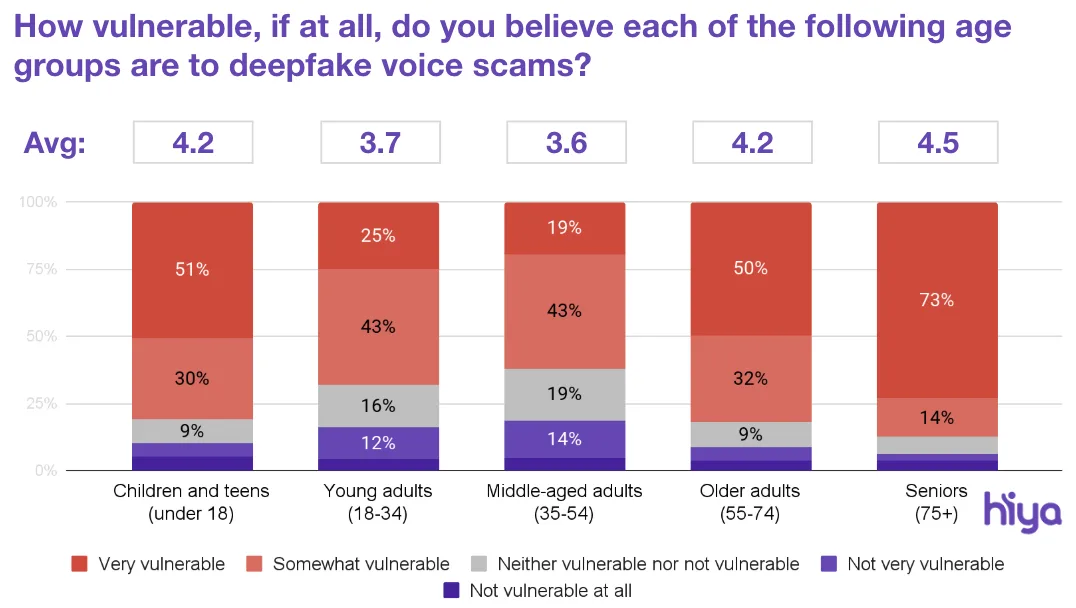
Senior citizens face the most serious financial damage from AI scams and voice fraud attacks. Adults aged 55+ lose an average of $1298 per scam incident, triple younger adults’ losses. Grandparent scam remains highly dangerous for families worldwide.
One respondent shared: “My 90-year-old mother received a scam call with a deepfake voice of her grandson asking for money… she refused to answer the phone unless someone was there with her for many months.” AI fraud transforms phones from trusted tools into fear sources globally.
To explore how Security Operations Centers (SOC) play a crucial role in defending against modern cyber threats, read our latest SOC News.
Source: Businesswire


