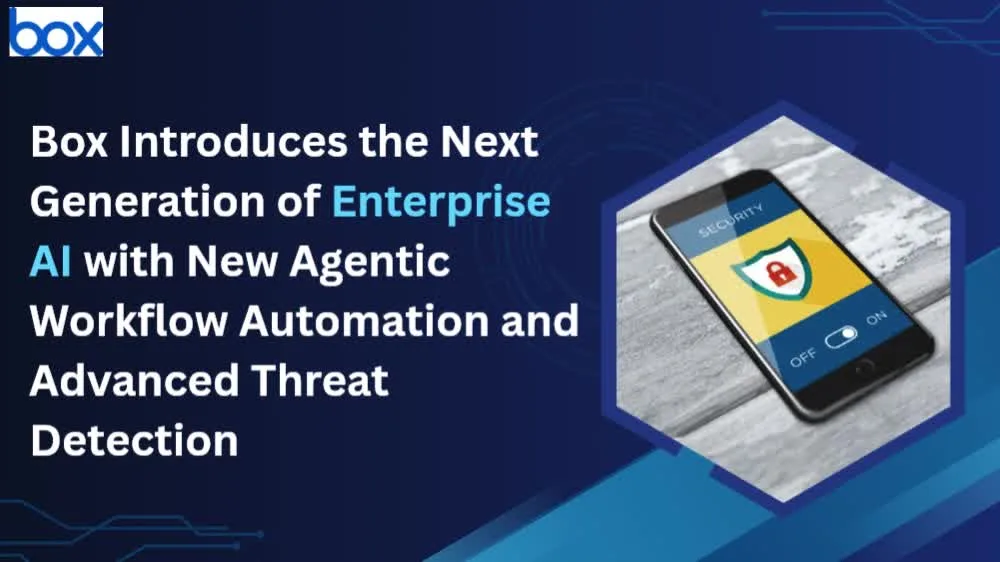
Box today announced new capabilities to transform business processes. Box revealed Box Architect to aid teams in constructing, managing, and enhancing their agentic workflow on their own. The software brings a new dimension to how companies use AI in their operations. In addition, Box launched its advanced threat protection solutions for securing enterprise content from cyber threats.
With Box Architect, teams can leverage frontier AI to create custom applications and automations. Users build each agentic workflow directly on trusted content and existing permissions within Box. Meanwhile, new security capabilities help detect agentic attacks like bulk exfiltration and account takeover. These security measures complement existing agent security controls to govern file access effectively. Box unveiled these features at BoxWorks 2026 in San Francisco.
“The real opportunity with AI is not just helping individuals work faster, but rethinking how entire business processes get done,” said Aaron Levie, co-founder and CEO of Box. “Until now, putting AI to work across those processes has often required specialized expertise and significant effort, but breakthroughs like OpenAI’s Astra and Anthropic’s Fable are changing what’s possible. That’s why we’re building Box Architect – to help teams turn these advances in frontier AI into workflows that bring together agents, people, and content. At the same time, as agents become more capable and the threat landscape grows more complex, organizations need to advance security alongside innovation. Box is helping them do both by protecting enterprise content and giving organizations the confidence to explore what’s possible with AI.”
Deploying autonomous systems across enterprises often presents operational challenges. Box Architect solves this problem by allowing teams to deploy agents safely. Users can transform complex operations into a repeatable agentic workflow while keeping people involved at key decision points.
Moreover, teams can connect tools like Box Extract, Box Automate, and Box Sign smoothly. Customers can select leading models from Anthropic, OpenAI, Google, NVIDIA, and IBM. Consequently, users match specific tasks with the most cost-effective AI model available.
Users design a custom agentic workflow by describing goals in simple natural language. Following this, the process tests can be done using actual enterprise data. Lastly, full automations will be deployed using standard document templates.
Across industries, companies apply these features to streamline daily operations:
- Law firms review contracts against internal compliance playbooks automatically.
- Banking institutions orchestrate client onboarding across forms and signatures.
- Government agencies review public permitting documents under strict retention policies.
- Insurance providers process complex claims files through unified digital pipelines.
- HR departments verify employee onboarding packets and route exceptions for review.
“Enterprise AI maturity is moving beyond isolated conversational interfaces into autonomous process orchestration grounded in enterprise content,” said Alan Pelz-Sharpe, Founder, Deep Analysis. “While legacy approaches require brittle point-to-point configurations for extraction and execution, an integrated agentic design layer dynamically orchestrates content understanding, process steps, and analytical visualization within a single governed ecosystem. This enables organizations to drive measurable business transformation rather than fragmented tactical automation.”
Advanced Cybersecurity Controls Safeguard Enterprise AI Deployments
As autonomous agents access enterprise files, organizations require stronger security guardrails. Therefore, Box extends content-layer protection to detect automated security threats rapidly.
The capabilities for detecting anomalies include blocking any exfiltration attempts in file downloads. Moreover, the session binding capabilities help prevent stolen user credentials from being exploited by any other device. Another capability of the system is to detect any file sharing and mass deletion of files.
In parallel with that, the company offers improved controls for the active agentic workflows through the Box service. First of all, it helps set the classification policies in order to limit access to any sensitive files. Second of all, the teams may use MCP Guardrails in order to control the actions of the agents on the sensitive files. Finally, the thresholds help notify the IT professionals in case any agent performs an action exceeding the level of safety.
Therefore, enterprises will be able to manage an agentic workflow in a secure way.
To explore how Security Operations Centers (SOC) play a crucial role in defending against modern cyber threats, read our latest SOC News.
News Source: Businesswire