


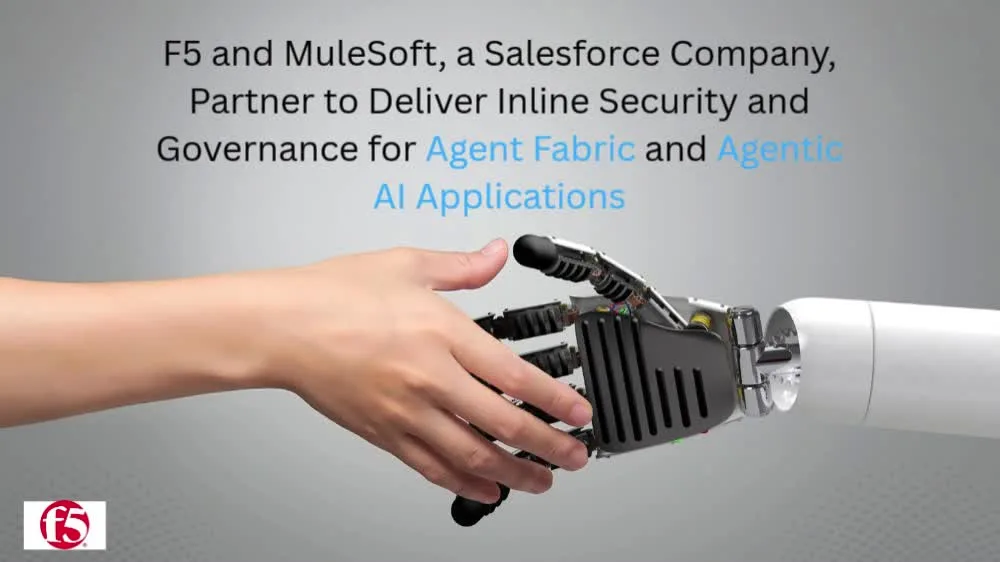
F5 announced a technology partnership with MuleSoft today. MuleSoft is a leading subsidiary of Salesforce. This partnership brings F5 AI Guardrails right into Agent Fabric. The native integration gives immediate power to platform engineering teams. Live apps can have centralized security policies applied by engineering teams. They prevent malicious prompt injections without any infrastructure change.
Companies are quickly creating networks of autonomous agents. Operations often suffer from significant visibility gaps for security teams. This leaves unmonitored systems more vulnerable to data leaks. Critical workflows are under active attack by toxic prompt injections by cybercriminals. MuleSoft integrates F5 runtime security to combat these threats. The integration connects directly through the Agent Fabric Omni Gateway. Thus, administrators have continuous control of all system traffic.
Closing the Governance Gap for Agentic AI
Companies would make complicated technical trade-offs to secure their workflows. Security teams route traffic through external inspection layers. Otherwise, they rely on limited native gateway controls. However, MuleSoft solves this operational dilemma through direct federation. The platform inspects inbound prompts before invoking underlying models.
Furthermore, this joint architecture delivers unified control across enterprise deployments. MuleSoft supports existing Agentforce ecosystems alongside custom applications. Security teams author dynamic policies within the F5 console. Subsequently, Omni Gateway updates rules without code adjustments.
Furthermore, the system preserves critical data residency standards. Flexible deployment options support self-hosted Kubernetes clusters within private clouds. Therefore, sensitive customer records stay strictly within corporate boundaries. Additionally, detailed event telemetry simplifies compliance auditing for global standards.
“AI agents are moving from experiments into the critical path of the enterprise,” said Kunal Anand, Chief Product Officer at F5. “The biggest risk in agentic AI is that agents will move faster than enterprise security and governance models can keep up. By integrating the F5 AI Security Platform directly into Agent Fabric, we are putting protection in the path of every prompt and response, where it can operate in real time. That lets organizations move faster with AI while preserving the control, visibility, and accountability their most important business processes demand.”
“We built Agent Fabric as the neutral solution to support enterprises running agents across a mix of models and platforms,” said Andrew Comstock, SVP & GM at MuleSoft. “By extending Agent Fabric’s existing LLM API and AI services to support F5 AI Guardrails as a first-class provider, we’re making it even easier for customers to scale their agentic enterprise on the security tooling they know and trust.”
Availability and Dreamforce Demonstration
F5 AI Guardrails for Agent Fabric is now generally available. Consequently, enterprise teams can implement these protections immediately. Furthermore, MuleSoft will demonstrate these capabilities at Dreamforce in San Francisco. Attendees can explore runtime governance strategies throughout the event.
To explore how Security Operations Centers (SOC) play a crucial role in defending against modern cyber threats, read our latest SOC News.


