NETSCOUT today officially launched an upgrade to its Adaptive DDoS Protection system. Consequently, service providers can now automatically detect and mitigate outbound cyber threats.
Furthermore, this expansion targets weaponized IoT Devices that generate massive botnet attacks. Modern cyber criminals actively compromise smart routers and home hardware. Therefore, security teams require modern automated defenses to block outbound traffic.
Without proper defense, infected IoT Devices generate multi-terabit network attacks. Consequently, these malicious bursts cause costly service outages for global operators.
Furthermore, outbound attack spikes damage vital peering relationships between service providers. Therefore, blocking compromised IoT Devices preserves network stability and reduces transit costs.
In addition, early threat suppression protects service providers against severe reputational harm. By blocking compromised IoT Devices at the source, operators reduce customer churn.
Moreover, early mitigation lowers regulatory risk across global telecommunication networks. NETSCOUT provides these advanced security features through its Arbor Sightline system. In addition, the solution leverages the powerful Arbor Threat Mitigation System.
“The combination of higher-speed broadband connectivity and vulnerable IoT devices has been weaponized by a new class of massive DDoS botnets,” said Patrick Donegan, founder and principal analyst, HardenStance. “Source-side mitigation, or attack suppression as it’s sometimes known, is a critical part of the equation. NETSCOUT’s approach, backed by its ATLAS Intelligence Feed (AIF) and ASERT analysts, gives service providers the tools they need to detect and stop attacks before they have an impact, protecting their customers and the broader internet from the large-scale DDoS attacks we have seen.”
AI-Driven Threat Intelligence and Automated Defense
The platform utilizes advanced artificial intelligence to analyze massive internet traffic volumes. Specifically, the system uncovers hidden malicious data streams inside legitimate network flows.
Furthermore, the technology dynamically redirects malicious traffic to preserve clean data operations. Consequently, security teams neutralize malicious IoT Devices before outbound traffic leaves local networks.
In addition, the solution draws real-time data from the ATLAS Intelligence Feed. This security network constantly monitors nearly half of all global internet traffic.
Therefore, operators gain localized threat intelligence tailored to their specific networks. Consequently, service providers pinpoint compromised IoT Devices with precise accuracy.
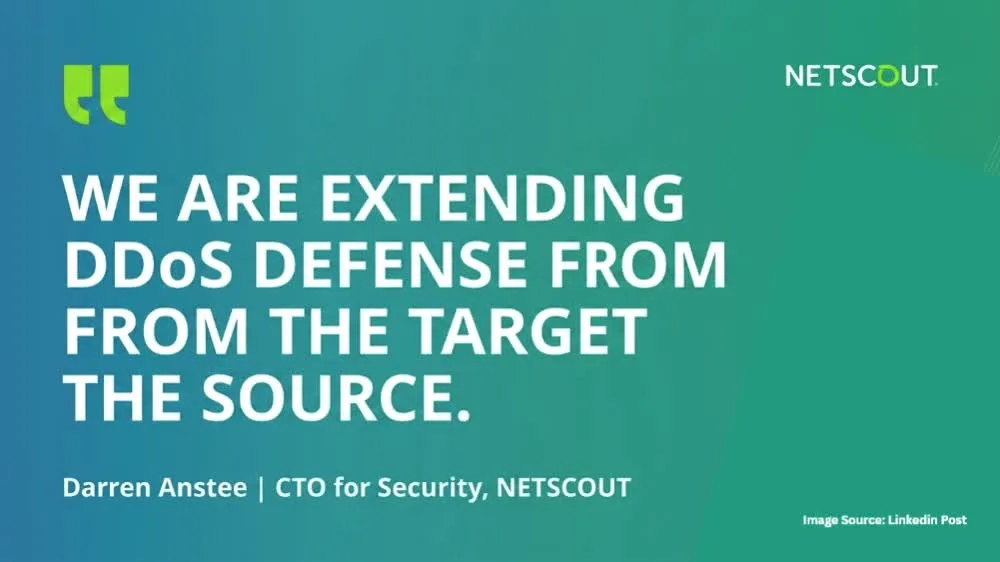
“We are extending DDoS defense from the target to the source,” stated Darren Anstee, CTO, Security, NETSCOUT. “By using our internet-scale visibility to derive localized threat intelligence for our customers, NETSCOUT can identify and precisely suppress attacks at their origin, before they cause problems locally or at their target. This capability gives our customers a new level of comprehensive defense across their peering, transit, cloud and customer edges.”
Ultimately, this technology expansion reinforces long-term network resilience for global providers. By extending security workflows to outbound threats, NETSCOUT improves cost controls. Thus, telecommunication firms protect their infrastructure while delivering reliable connectivity.
For related updates on digital trust and cybersecurity, explore our SOC News.