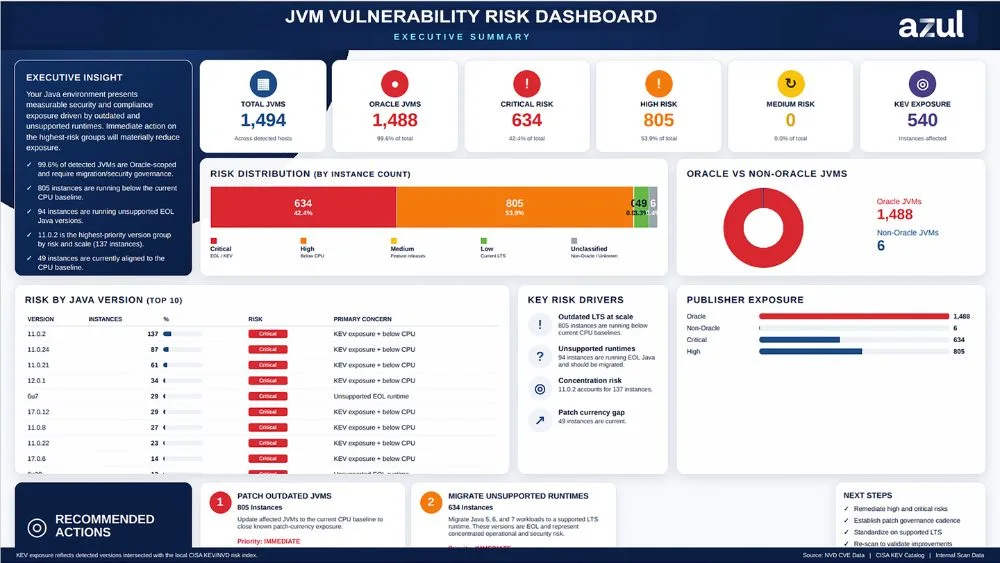
Azul, the trusted leader in enterprise Java solutions for AI and cloud-first environments, has launched a free JVM vulnerability risk assessment to help organizations identify hidden security risks across their Java environments.
The new assessment addresses a growing security challenge as autonomous AI exploitation tools become increasingly capable of finding vulnerabilities. Unmanaged Java estates have become a major enterprise security concern with mean time to exploit (MTTE) shrinking from months to days or even hours.
JVM vulnerability risk assessment delivers comprehensive insight into underlying risk in Java runtime environments to DevOps and SecOps teams. It also helps organizations to identify security vulnerabilities before cyber attackers find them and exploit them.
Azul developed this program to strengthen the security, licensing, and compliance solutions available through Azul’s trusted partners. The company is still dedicated to helping enterprises keep Java infrastructure secure and reliable.
AI-Powered Threats Raise the Bar for Java Security
Cyber exploitation at a high level of sophistication was the realm of highly skilled attackers for many years. Finding zero-day vulnerabilities took extensive knowledge of the JVM, reverse engineering skills, and months of technical research.
But the cybersecurity landscape has evolved significantly. Now, attackers can use artificial intelligence to find unknown vulnerabilities and develop ways to exploit them more quickly.
Anthropic’s Claude Mythos shows that AI systems can identify vulnerabilities on their own and create possible exploitation tracks. This enables attackers to achieve more with fewer technical resources than traditional approaches.
Organizations are therefore exposed to a wider range of potential threats. “Previously, the mean time to exploit was measured in months. Now attackers can potentially cut that timeline down to days or even hours.
At the same time, many enterprises continue to grapple with slower remediation for non-critical Common Vulnerabilities and Exposures (CVEs). Organizations running legacy Java versions in large Java environments, with unmanaged JVMs and little or no runtime visibility, are therefore at heightened security risk.
Azul’s assessment provides businesses with insights into their Java security posture. It also enables teams to prioritize vulnerabilities based on business impact and risk exposure.
Assessment Offers Full Java Estate Visibility
Azul’s JVM Vulnerability Risk Assessment is available free of charge through Azul and select partners. The assessment provides enterprise security teams with a number of capabilities.
Organizations get an executive-ready security dashboard, offering visibility into their Java estate. The dashboard includes risk levels, publishers and Java versions to report to leadership.
The assessment also identifies which versions of Java create the most security exposure. This allows teams to focus remediation efforts where it matters most, instead of applying a broad fix.
The solution also offers Key Risk Indicators (KRIs) associated with AI-driven exploits. It detects JVM environments with Known Exploited Vulnerabilities (KEVs), end-of-life versions, and old patch levels.
Azul also provides a prioritized remediation roadmap. This roadmap offers recommendations on workloads needing immediate patching, migration or extended support solutions.
“Through our strategic partnership with Azul, we significantly reduced our security risk level with our Java applications and Java-based infrastructure, which certainly helps me sleep better at night,” said Jenny Nelson, head of ICT & Digital at Newcastle City Council. “In addition, the benefits of switching to Azul Core as our JVM are clear. Our Java estate is now consistent, standardized, easier to maintain, and has brought a level of simplicity that’s a huge benefit to our organization.”
Security Patch Management Becomes Critical Defense
As AI-powered attacks continue evolving, organizations must improve Java security practices. Regular security updates remain one of the strongest defenses against known vulnerabilities.
Java’s quarterly updates provide essential fixes for identified security issues. However, autonomous AI systems can discover vulnerabilities and combine existing weaknesses into new attack methods.
Azul addresses this challenge through a multi-layered enterprise Java security approach. The company provides stable Critical Patch Updates (CPUs) that include current CVE fixes without unnecessary production disruption.
Furthermore, Azul delivers emergency security fixes when critical vulnerabilities require immediate action. The company works with the Java community to ensure secure and reliable updates.
Azul also provides complete JVM visibility across enterprise environments. This includes embedded and unmanaged runtimes that traditional asset discovery methods may overlook.
No security scanner, SIEM platform, or EDR solution can identify vulnerabilities that remain undisclosed. Therefore, maintaining an updated Java environment reduces possible attack surfaces and improves enterprise resilience.
Regulated Industries Need Stronger Java Security Controls
Financial services, healthcare, utilities, and government organizations face increasing security requirements. These sectors manage complex Java environments while following strict compliance obligations.
Regulations and frameworks such as PCI-DSS, SOX, HIPAA, DORA, NERC CIP, and FedRAMP require organizations to demonstrate software visibility and timely vulnerability management.
However, AI-driven exploitation methods do not differentiate between regulated and non-regulated organizations. Therefore, businesses must improve security visibility and accelerate patch deployment.
“Anthropic’s Mythos has shown that AI can now discover and weaponize vulnerabilities on its own — including flaws that survived decades of human review. That’s the real lesson for every CISO: the deep expertise that used to stand between attackers and your software estate is no longer a barrier,” said Scott Sellers, co-founder and CEO of Azul. “The unpatched JVM is already a growing liability, not a future one. Azul’s JVM vulnerability risk assessment was created to help security leaders find and close that exposure before AI-driven attackers can exploit it.”
Azul’s JVM vulnerability risk assessment identifies JVM exposure, KEV risks, and patch gaps throughout enterprise Java environments. Additionally, it provides organizations with a practical remediation roadmap.
The assessment can operate as a standalone Java runtime vulnerability analysis. It can also support existing security, licensing, and compliance services provided through Azul partners.
For related updates on digital trust and cybersecurity, explore our SOC News.
Source: Businesswire